
GE / IP FANUC Series 90/30 In Stock


Advantages of Fiber Optics Utilization in Industrial Automation
For industrial automation, a key challenge is managing the data generated from all components. A scalable and adaptable infrastructure is a key to linking, processing, and analyzing this huge data in real time. These infrastructures are best designed by using fiber optic technology. They exchange data via light pulses, which allows them to be extremely rapid. They don’t produce electromagnetic noise in the same manner that other systems do. Furthermore, because fiber optic cables are light and flexible, they take up significantly less area than traditional cable-supported networks.
Industrial automation systems have significantly more rigid standards than commercial networks. They require networks that can endure severe environments like electromagnetic interference, extreme weather conditions, and temperature fluctuations, and they must be put in hazardous situations in some circumstances. In such cases, traditional copper conductors cannot be utilized with confidence, although fiber-optic connections may.
Fiber optic cabling is extensively utilized in industrial automation applications to provide very dependable networking equipment that does not fail, allowing revenue generation and worker safety to be maintained. These fiber optic-based networks are now assisting in the development and implementation of a wide range of smart technologies in the industry, including mobile robots and autonomous cars.
Over the last decade, the use of fiber optic data transmission for industrial automation and process control has grown in popularity. In this article, we will focus on all the advantages that fiber optics can bring to industrial automation.
What is Fiber Optics? How does Fiber Optics work?
Fiber optics, often known as optical fiber, is a technology that transfers data as light pulses via a glass or plastic fiber. Fiber optics is a transmission medium – a “pipe” that can transmit signals across vast distances at fast rates. In fiber optics, the light signals are encoded with data at the transmitting source – the same data you see on a computer screen. As a result, the optical fiber sends “data” as light to a receiving end, where the light signal is processed as data.
Light signals do not move at the speed of light due to the denser glass layers. But rather at a rate that is approximately 30% slower than the light speed. Sometimes, fiber optic transmission may need the use of repeaters at regular intervals to refresh or amplify the signal during its travel. The optical signal is regenerated by these repeaters by converting it to an electrical signal, processing that electrical signal, and retransmitting the optical signal.
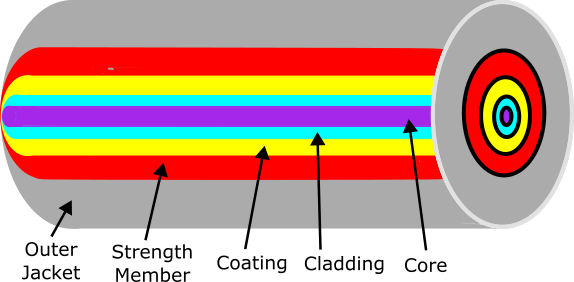
A fiber optic cable is composed of five components:
- Core: The “core” is made up of optical fibers, which are extremely thin strands of glass or plastic.
- Cladding: The “cladding” is an insulated shell that surrounds the “core” and provides a reduced refractive index to allow the optical fiber to function.
- Coating: The “coating” is an optical fiber’s protective covering.
- Strengthening: “Strengthening,” or strengthen member, protects the core during installation from crushing pressures and excessive stress.
- Outer jacket: An outer jacket, as the name indicates, is intended to protect the cable from environmental threats.
Light moves along a fiber-optic cable by bouncing off the walls repeatedly. Each small photon (light particle) bounces down the pipe. You may anticipate a light beam going through a clear glass pipe to simply leak out the corners. However, if light strikes the glass at a very shallow angle (below 42 degrees), it reflects in, as if the glass is a mirror. This is known as total internal reflection. It is one of the components that retain light within the pipe.
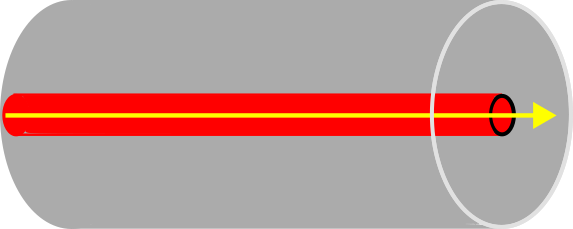
Single-Mode Fiber:
Because of the small diameter of the glass fiber core, single-mode fiber is employed for longer distances. This small-diameter reduces the potential of attenuation, or signal intensity loss. The smaller hole concentrates the light into a single beam, providing a more direct path and allowing the signal to go further.
Single-mode fiber offers far higher bandwidth than multimode fiber. A laser is often utilized as the light source for single-mode fiber. Single-mode fiber is typically more costly due to the exact calculations required to create laser light in a smaller hole.
Multimode Fiber:
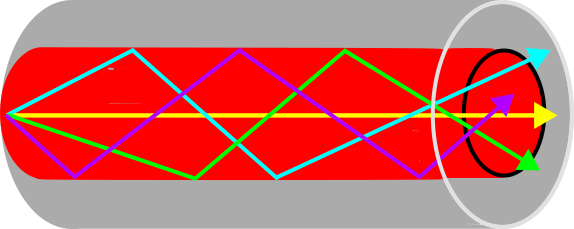
Because the bigger core opening allows light signals to bounce and reflect very much along the way, multimode fiber is employed for shorter distances. Because of the larger diameter, several light pulses may be delivered through the cable at the same time, which results in increased data transfer. However, this increases the potential for signal loss, attenuation, or interference. The light pulse in multimode fiber optics is usually generated by an LED (light-emitting diode).
Advantages of Fiber Optics:
Fiber Optics offers the following advantages:
1. Wider Bandwidth and High-Speed Data Communication:
Optical fiber provides greater bandwidth and faster communication rates. In industrial applications, a single optical fiber can carry up to 10 gigabits per second (Gbps). As compared to the bandwidth of fiber optic, the copper cables’ bandwidth is more limited in terms of both speed and frequency. The frequency range over which data can be transmitted with optical fiber is thousands of times wider than the frequency range of copper cable. That’s why optical fiber allows the fiber to carry much more information per second. Furthermore, copper cable transmits data more slowly because it uses electrical signals that cannot travel nearly as fast as light-based signals in optical fiber.
While designing an industrial automation system based on fiber optic, the bandwidth of the fiber is an important consideration. Because the bandwidth of a channel describes the range of frequencies and data rates that can be transmitted through it.
2. Small Size:
The strands of fiber optics are incredibly thin. They are measured in micrometers or millionths of a meter. The most frequently used fiber optic strand is as thick as human hair. Nonetheless, as discussed above, It can carry enormous volumes of data at far faster speeds and over much longer distances than its less thin copper version.
Fiber optic cables still need protective sheathing, adding at least two millimeters to their width. However, a single conventional category 6 copper cable is still about four times wider and can only carry a fraction of the data. By using fiber optics in industrial automation, you can save a lot of space. The freed-up space can allow for better circulation of cooled air in a data center.
3. Light Weight:
Fiber-optic cables are much lighter than electrical cables. Fiber optic cables are thinner and composed of glass or plastic. That’s why they are lighter and easier to install.
4. Electrical Isolation:
Fiber optics offer electrical isolation and protects personnel as well as attached equipment from lightning strikes, floods, and electrical defects. For example, in the case of a ground fault or high currents, an induced electrical potential difference is induced between different locations. This potential difference is dangerous to equipment as well as personnel. However, the use of fiber optics instead of electrical cables provides the necessary electrical isolation that can significantly reduce the dangers to humans and equipment.
5. Immunity to Electromagnetic Interference:
The electrical signaling in a copper cable produces a field of interference around it. When several cables are running closer to each other, this interference can infiltrate the surrounding cables and affects the desired messaging.
However, because optical fiber is electrically non-conductive, it is completely immune to electromagnetic interference. That’s Why the transmission of fiber optics is nearly noise-free. That enables very reliable networks in electromagnetically crowded industrial environments.
It is unavoidable in real cable deployment to encounter settings such as power substations, heating, ventilation, and other industrial sources of interference. However, because fiber is so resistant to electromagnetic interference, it has a really low bit error rate.
6. Optimal Security:
Fiber optics is inherently secure. Because optical fiber does not transfer electrical power, it doesn’t emit signals and thus cannot be tapped. In fiber optic transmission, data or signals are transmitted via light. As a result, there is no way to discover the data being communicated by “listening in” to the electromagnetic energy “leaking” through the wire that ensures complete information security in fiber optics. Besides, fiber optic signals are also resistant to hacking, and built-in diagnostics may detect intruders. That’s why many industries are employing fiber optics because of security concerns.
7. Low Transmission Loss and Greater Distances:
The transmission loss determines how far a signal may go in a cable before the optical power gets insufficient to detect. Optical fiber has much lower transmission losses than copper. Although both copper and fiber-based signaling is subjected to attenuation or signal weakening over distance. Fiber optic cables can still carry data over far greater distances.
Copper cable lengths are limited to 100 meters (330 feet) under regulating requirements. Longer lengths are theoretically conceivable, but they may create additional issues, prohibiting copper from being a viable transmission technology over longer distances. Depending on signaling and cable type, fiber optic may transport data for over 24 miles.
8. Stability in Harsh Environments:
Fiber optic cables can endure harsh environments such as temperatures ranging from -20 degrees Celsius to +105 degrees Celsius (-4 to +221 F), high vibrations, exposure to typical industrial oils, and chemicals, and noise.
9. System Reliability:
Fiber optics is substantially more resistant to environmental influences than copper wire. For example, although copper degrades significantly over a two-kilometer distance, fiber optics may offer extremely reliable data transmission over the same distance. Furthermore, as mentioned above, fiber is resistant to various environmental conditions such as temperature and electromagnetic oscillations. That’s why it can be installed next to industrial equipment with assurance.
10. Very Low Power Consumption:
Fiber optics-based networks are more power efficient. As they consume way less power than copper-based networks.
11. Longer Life:
Fiber optic cables are built to survive for years, if not decades when properly installed and maintained. Life expectancy can be greatly increased if proper care is taken during installation and afterward. The calculated lifespan of fiber optics is around 30 – 50 years.
12. Flexibility:
Optical fiber is also flexible due to its small diameter and substantial strength. The fiber can be damaged due to the tight bends, but the soft fiberglass strength components around the fiber and the soft jacket will shield it and keep it from breaking.
13. Ease of Maintenance:
Optical fiber systems are simple to maintain and do not require any additional resources. Aside from that, you may enhance the system through increments and redesigns. Setup and support do not need substantial talents or equipment.
14. Wider Scope of System Expansion:
Because fiber optics are more scalable, they can easily accommodate adjustments, expansions, and upgrades. Wavelengths may be turned on or off as needed. This allows for flexible service supply and rapid scaling for a growing firm. Moreover, optical fibers are substantially smaller and lighter than copper cables. These fibers can normally be installed in anticipation of future growth requirements of 15 to 20 years. Additionally, It also allows further optical fibers to be added afterward for network expansion.
15. Diversity of Signal Transmission:
Optical fiber can transport a wide range of digital and analog signals, such as contact closure information. As a result, fiber optics make use of high-quality converters that transform electrical signals to and from optical data streams. This technology also supports copper/fiber media conversion of serial protocols such as Recommended Standard 232 or 485, Ethernet, Ethernet Industrial Protocol, ControlNet, Profibus (Process Field Bus), Data Highway Plus, Modbus Plus, and Genius Bus.
16. Higher Strength to Support Industries:
Fiber optics are designed for the roughest environments, leveraging a data defect in a key industrial process. As a result, fiber optics are regarded as highly ideal for supporting mechanical parts that outperform manufacturing in the industrial sector.
Remarks:
The use of fiber optic cabling in industrial automation applications can provide a very reliable network that does not fail, allowing revenue generation and worker safety to be maintained.
This entry was posted on July 7th, 2022 and is filed under Education, Technology, Uncategorized. Both comments and pings are currently closed.
PDF Supply sells used surplus products. PDF Supply is not an authorized distributor, affiliate, or representative for the brands we carry. Products sold by PDF Supply come with PDF Supply’s 1-year, 2-year, or 3-year warranty and do not come with the original manufacturer’s warranty. Designated trademarks, brand names and brands appearing herein are the property of their respective owners. This website is not sanctioned or approved by any manufacturer or tradename listed.
Rockwell Disclaimer: The product is used surplus. PDF Supply is not an authorized surplus dealer or affiliate for the Manufacturer of this product. The product may have older date codes or be an older series than that available direct from the factory or authorized dealers. Because PDF Supply is not an authorized distributor of this product, the Original Manufacturer’s warranty does not apply. While many Allen-Bradley PLC products will have firmware already installed, PDF Supply makes no representation as to whether a PLC product will or will not have firmware and, if it does have firmware, whether the firmware is the revision level that you need for your application. PDF Supply also makes no representations as to your ability or right to download or otherwise obtain firmware for the product from Rockwell, its distributors, or any other source. PDF Supply also makes no representations as to your right to install any such firmware on the product. PDF Supply will not obtain or supply firmware on your behalf. It is your obligation to comply with the terms of any End-User License Agreement or similar document related to obtaining or installing firmware.